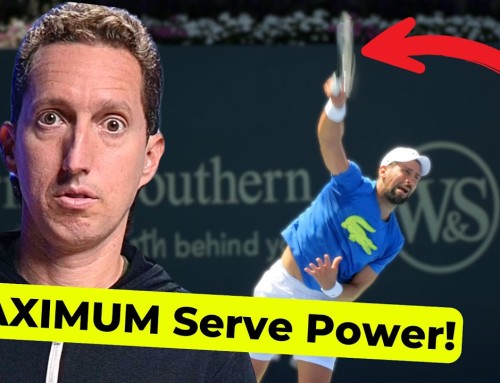
I want to show you how one of my students went from a weak, unathletic motion to a powerful tennis serve in just fifteen minutes of work together, because the fix was so much simpler than most players expect.
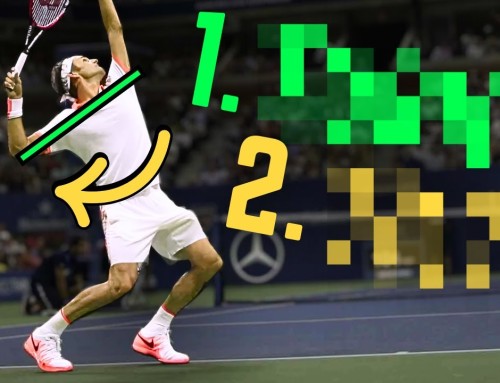
It all comes down to something tennis nerds like to call the “trophy pose” — that classic starting position you see in the middle of every serve, the one that looks like it belongs on top of a trophy (because, honestly, it kind of does).
Watch Roger Federer get into this position and you’ll notice something specific: his dominant arm stays in a strong line with the tilt of his shoulders and the turn of his torso.
That connection matters more than almost anything else in the serve, because it means his big, strong torso is leading the motion, and his arm is simply along for the ride.
The racket, in turn, just gets carried by the arm. Body leads, arm follows, racket comes along last.
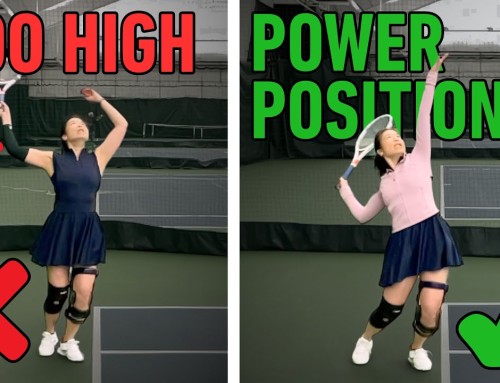
Now compare that to where my student started.
Her dominant arm never got anywhere close to that same alignment — it barely reached parallel to the baseline, while Roger’s and Novak Djokovic’s arms rotate significantly further back than that.
That difference might not sound like much, but it’s actually huge. It means her arm was operating completely independently of her body, arriving early and doing all the pushing on its own.
And an arm working alone is never going to compete with the strength of the torso, hips, and shoulders working together.
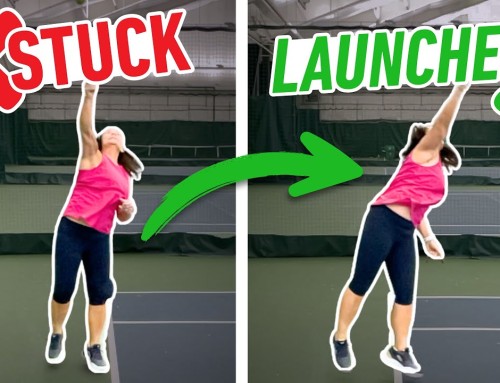
What she had, essentially, was a pushing motion — using the hand to shove the racket toward the ball — instead of a pulling motion, where the body’s rotation drags the arm and racket through a long, accelerating arc.
That longer arc is exactly what separates a weak serve from a powerful tennis serve.
So how did we fix it in just fifteen minutes? We broke it down into five simple drills, each building on the last.
First, we practiced getting into the new trophy pose with no ball and no racket motion at all — just the hands coming together and the body coiling into that stronger position.
Some exaggeration here is a good thing; it helps the body feel just how different this new shape is from the old habit.
Second, we added the full motion without a ball — from trophy pose, through racket drop, all the way to a simulated point of contact — always reinforcing that the torso leads and the arm follows.
Third, we brought in what I call a “fake toss.” I tossed the ball off to the side so my student didn’t have to manage her own toss yet.
This let her put all her focus into the new body-led motion without the added coordination challenge of tracking a ball she was about to hit.
Fourth, we moved to shadow swings paired with that same fake toss — and this is where you could really see it click.
Her torso was pulling her arm around beautifully.
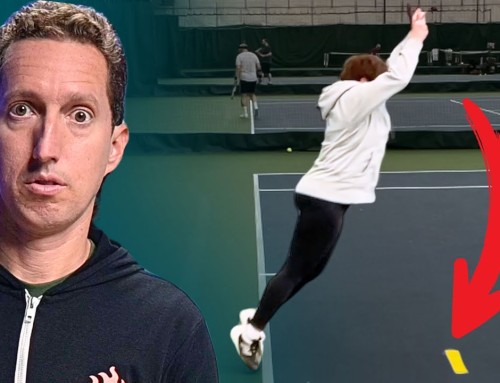
But the moment she tossed the ball herself and had to actually hit it, her old habit crept right back in, and her arm shot straight back out to that old, weak, parallel position.
That’s not a failure — that’s completely normal. The eyes lock onto the ball, the brain reverts to autopilot, and old patterns resurface fast.
This is exactly why shadow swings and fake tosses matter so much: they let you bank quality repetitions in the new pattern before your nervous system has a chance to sabotage you.
Fifth, we alternated between shadow swings and real hits to build up repetition under slightly more realistic conditions.
By the end, her elbow was staying back significantly longer than where she started, even though old habits still occasionally snuck in.
That’s not a finished product — but it’s a real foundation, and one she can keep training at home.
If you take one thing from this, let it be this: change happens in layers.
Don’t expect to toss a ball up and instantly own a brand-new motion.
Build it without the ball first, then add the ball back in slowly, and give yourself grace when the old pattern resurfaces — because it will, at least for a while.
Thanks for reading, and I’ll see you in the next lesson.
Your Coach,
-Ian