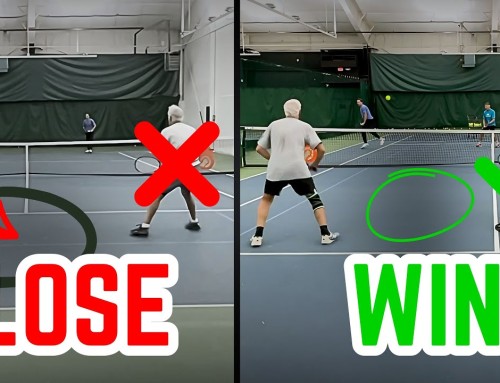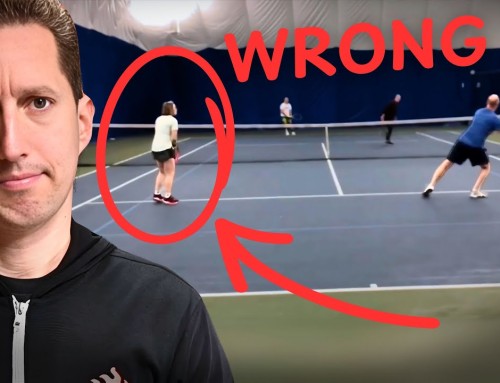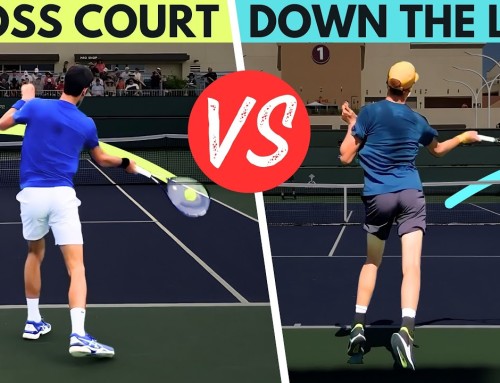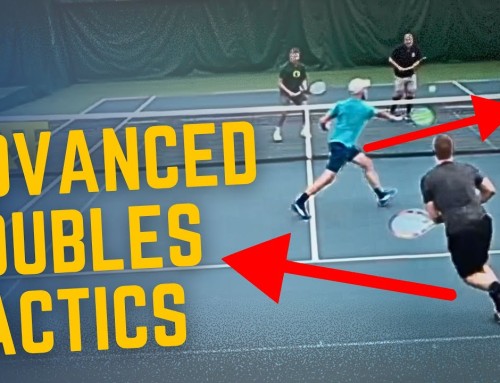
Doubles players leaving the middle wide open is the most common way strong teams hand away easy points.
You think you’re covering the center, but you’re probably not.
Even strong 4.0 players, like these recent students, make all four mistakes that open the door.
Unless you’re already a 4.5, I promise you’re guilty of them too.
Stay for the fourth one, because it’s the worst of all.
Mistake one: transitioning from defense to offense too soon.
Picture the serve landing in the box while I stand in a defensive net position back near the service line.
My opponent is up close to the net in an offensive position.
I wait and watch him like a hawk, guarding the middle against his potential attack until I know the ball has made it past him.
Only then do I move forward to attack, while he slides back toward the middle to defend.
But look at what happens when he hears the ball struck behind him.
He’s already walking forward, and the ball hasn’t come close to getting past me.
By the time he realizes I’m getting it, he’s too far from the center to stop anything.
That makes it easy for me to put the ball between him and his partner.
I see this at every level, and it makes the game far too easy for opponents.
Mistake two: not covering the actual center of the court.
Here’s the literal middle of the court.
That works only while the ball stays inside the red box.
The moment the ball leaves that box, the space between you and your partner starts stretching.
Watch the returner as my serve goes in.
One, two, three steps away from the middle, while his partner drifts the other direction.
The true center of the court is in one place, but the center between those two players is somewhere else entirely.
And that’s exactly where the ball goes.
It’s critical to move in sync with your partner.
If you don’t, you leave huge, open targets and make winning easy for your opponents.
Mistake three: parking in the wrong spot when the ball goes down the line.
This one is tricky, and I see it constantly.
The return of serve here is a lob.
Normally the ball travels crosscourt, and this player’s movement would make sense for that shot.
It would put him in front of the ball, ready to cover his alley or cut toward the middle to intercept.
But this ball isn’t going crosscourt.
It’s going down the line, and I run all the way over while he stays put.
Look at how much space sits to the right of that net player, roughly 80 percent of the court.
Now look at how little he covers on his left, maybe 2 percent.
I can block the ball into that enormous chunk of open court, and he has no chance to get involved.
On top of that, my partner is switching and acts like a screen, blocking any extreme angle I might try.
So his net position is useless, and the middle between him and his partner sits completely uncovered.
That lets me hit a casual shot down the line with no pressure at all.
Mistake four: overcovering the alley.
As promised, this is the worst of the bunch.
When your partner serves, you’re balancing two responsibilities.
Yes, be aware of the alley.
But don’t cover all of it, because shutting down the entire alley removes you from the center.
It’s always a bad trade to cover a difficult target while leaving an easy one wide open.
At the start, this player’s position is actually pretty good.
With a big step he could cover some of the alley, and with a big step the other way he could get involved in the middle.
But as the ball travels toward the box, he hops to his left.
Then he hops left again before he even knows where the ball is going.
This was the very first point we played all day.
I hadn’t hit a single shot down the line, not one in the entire set.
He simply has a habit and an instinct to hop toward the alley.
Now one full step shuts down the alley completely.
But look at the trade: an easy ball right over the center of the net that he can’t possibly reach.
You can see him looking at it longingly, wanting to be involved, unable to get there.
Here’s the same player at the net while his partner returns serve.
His partner hits a standard crosscourt shot, and he trails toward the alley, then adds one final hop to shut it down.
I know getting burned down the alley is embarrassing.
It feels terrible.
But here’s what feels worse: never being involved in the center and making your partner cover 80 percent of the court while you guard one of the toughest, lowest percentage targets.
If this is your habit from the very start of the point, winning at doubles becomes an uphill battle.
Fix these four habits, and doubles players leaving the middle wide open becomes a problem your opponents have to deal with instead of you.
If you want the step-by-step drills I used to fix all four problems with these players, tell me in the comments and I’ll make it the next lesson.
Thanks so much for reading. Keep up the great work on your game, and I’ll catch you in the next one.
Your Coach,
-Ian