Forehand racket lag is the hidden power source behind every pro forehand, and most everyday players never use it.
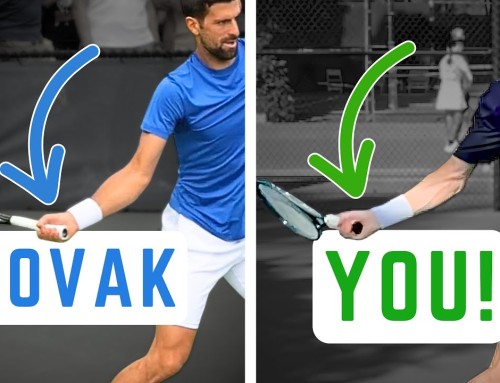
Watch for the angle between the forearm and the grip.
Carlos Alcaraz uses it. Coco Gauff uses it. Ben Shelton uses it. Holger Rune uses it. Aryna Sabalenka uses it. Stefanos Tsitsipas uses it. Jannik Sinner uses it.
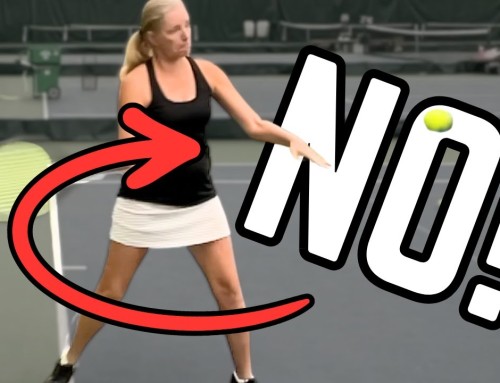
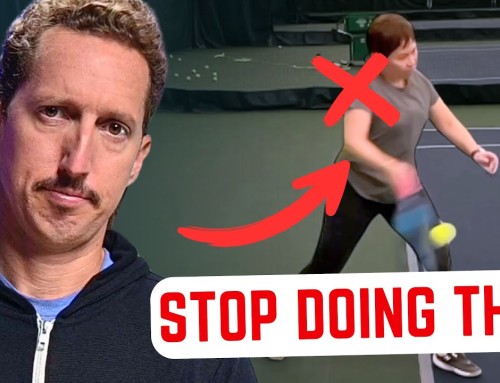
Everyday players don’t, and you’re probably not either.
That angle never shows up in their swings.
No angle. No angle. No angle.
They’re missing a huge power source: the dynamic stretching and releasing of the tip of the whip.
Here’s what I mean by the tip of the whip.
When a bullwhip cracks, it’s loud because the very tip breaks the speed of sound.
What you hear is literally a tiny sonic boom.
A skilled user creates a big circular wave of energy that travels the full length of the whip, and by the end, that built-up energy is massive before it snaps.
Now imagine the last foot of the whip was rigid, like a stick.
It would never crack again, because that stiffness breaks the wave of energy.
The circular build of force can’t snap the tip anymore.
That’s exactly what happens with competitive adult players.
They work incredibly hard to build energy and acceleration.
But the last 25 percent of what should be smooth, fluid, and circular is stiff and rigid.
So there’s no dynamic stretching or releasing of the wrist, forearm, or shoulder.
Now watch the pros again.
The hand, wrist, and racket tip move freely.
Everything from the shoulder down is loose and relaxed.
That lets the wave of energy build and snap freely through contact, which is the heart of forehand racket lag.
Before the solution, here’s a critical warning.
If you’ve watched plenty of technique breakdowns online, you already know this phenomenon exists.
But this is where everybody gets off track.
The lag and release of the racket head should be passive, not active.
The pros aren’t forcing a mechanical move to create that angle.
It happens automatically, because the torso starts the big circular swing while the shoulder, arm, wrist, and hand stay relaxed.
The harder you try to create it, the worse your forehand gets.
Deliberate flips or twists of the racket break the natural flow of energy.
That’s great news, because a few simple drills can create a major breakthrough.
Here’s a recent student who went from one swing to another in under an hour.
Watch his original forehand before any training.
Look at the relationship between his racket and forearm.
The angle stays exactly the same through the racket drop and all the way to contact.
There’s no change, no stretch, and no dynamic release.
The result is often a forced, mechanical flip of the racket afterward.
That makes no sense, because there was no circular release to begin with.
So the swing looks forced, angular, tight, and tense.
In slow motion, you can see no lag, no stretch, and a jerky finish.
He was trying to force a modern forehand.
After less than an hour of special drills, his forehand looked completely different.
Look at the angle between his racket and forearm now.
The follow-through is far smoother and more natural.
Energy now releases dynamically through the ball, and the tip of the whip is free to move.
That creates a passive stretch and then a natural release.
He now has dramatically more potential for power, spin, and control, as long as he keeps practicing this new approach.
Want the step-by-step drills I used, with a detailed description so you can achieve the same transformation?
Tell me in the comments, and if enough people want it, I’ll make it my very next lesson.
Thank you so much for reading, and keep up the great work on your game.
Your Coach,
-Ian