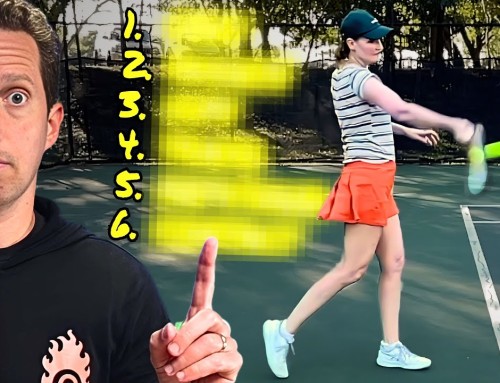
Carlos Alcaraz has one of the best forehands in the world right now. And I mean that without any hesitation.
The power, the spin, the consistency under pressure — it’s a weapon that makes even the best players on tour uncomfortable. So let’s break down exactly how he does it, because the Carlos Alcaraz forehand secrets are something every tennis player can learn from regardless of their level.
It starts with his grip.
If you zoom in on his hand at contact, you’ll see the big knuckle of his index finger sitting clearly on bevel number four. That’s a semi-Western grip. Not the Eastern grip on bevel three, which sits more on the flat side of the handle. The semi-Western gives Carlos an ideal balance between two things — energy traveling through the ball for power, and energy traveling upward past the ball for spin. That balance is everything on a forehand, and it all begins with how the hand sits on the racket.
Now let’s talk about where his real power comes from — because this is the part most players get completely wrong.
Watch his belly button.
As he sets up for a forehand, his belly button is facing the side fence. Fully sideways. Then as he swings through and the ball touches the strings, his belly button has rotated all the way around to face his target on the other side of the net. That rotation — his hips, his torso, his chest, his shoulders all unwinding together — that is the engine of his swing. That’s the primary power source.
A lot of everyday players reach the point of contact with their body still partially or even fully sideways. When that happens, the arm has to produce all the energy on its own. And an arm swinging alone is a fraction of what a full body rotating together can produce. You’ll also notice that space between Carlos’s body and the back of his racket at contact — that gap exists because his body is rotating so aggressively that the racket gets flung out in front. Players who try to create that space manually with their hand and arm are doing it backwards. The rotation creates the gap. Not the other way around.
His weight transfer is another piece of the puzzle, and it shows up differently depending on the situation.
On a step-in forehand, his back foot starts flat and planted, his front foot has almost no weight on it, and then as he swings through, all of his momentum and balance shifts forward onto that front foot. His back foot lifts. That forward shift of body weight adds another layer of energy through the point of contact.
On an open stance, he doesn’t step in — but watch how his weight still starts loaded on his right foot and then transfers over to his left as his body unwinds. He’s managing momentum even without stepping forward.
And then there are the situations where he’s actually falling backward as he hits — a deep, hard shot pushing him back off the ball. Even then, his belly button still rotates and transitions forward. Even falling away from the shot, his body still unwinds and the rotation still drives the racket. That’s how dominant his core rotation is. It shows up no matter what his feet are doing.
Now let’s talk about topspin, because this is where the second of the Carlos Alcaraz forehand secrets really comes into focus.
Topspin is what allows you to swing hard and still keep the ball in play. The forward rotation of the ball curves it back down into the court, giving you safety and margin over the net. And the way you create that forward rotation is with the vertical element of your swing — the upward path of the racket past the back of the ball.
Here’s how to think about it. A completely flat swing sends all of its energy through the ball toward the target — maximum power, but almost no curve, almost no margin for error. A completely vertical swing sends all of its energy upward past the ball — lots of spin and curve, but very little pace or penetration. Neither extreme is useful on its own.
What Carlos does — and what the best players in the world all do — is find roughly a 45-degree angle of racket path from the bottom of the swing through the point of contact and beyond. About half the energy going forward through the ball. About half going upward past it. That’s the mix that gives you both pace and curve. Power and safety working together at the same time.
He adjusts this depending on the height of the ball too. On a high contact point at shoulder height, he doesn’t need to drop the racket far below the ball — the height is already there. On a low contact point at knee height, he tilts and dips his upper body to get the racket face a full foot below the contact point so he can still achieve that upward lift through the swing.
Different situation, same principle. Always creating that vertical space to work with.
The last thing I want to point out is something that rarely gets talked about but is one of the most visible Carlos Alcaraz forehand secrets when you watch him closely.
His eyes never leave the contact point.
Through the swing, through contact, deep into his finish — his face stays completely fixed on where the ball just was. He doesn’t look up to see where it’s going. He trusts the shot and keeps his head still. This helps his balance, his focus, and his ability to make clean repeatable contact.
It’s extremely counterintuitive. Every instinct you have wants to look up and see the result. But the discipline to keep your eyes at the contact point even as you’re sending all of that energy in the opposite direction is something worth developing.
And here’s what I love about this — even Carlos shanks the ball sometimes. In the middle of a simple down-the-middle rally, watching the ball perfectly, one of the best players in the world still hits it off the frame. That’s tennis. It happens to everyone. Don’t obsess over the occasional mishit. Keep working on the right things and the results will follow.
Study these pieces, work on them one at a time, and you’ll start to feel what it’s like to have a forehand that does what you want it to do under pressure.
Your Coach,
-Ian